Just below the surface of the Mediterranean Sea, only a few metres from the beaches where millions of people swim every summer, lies a forest that few people see and even fewer truly know. It is Posidonia oceanica, a marine plant found exclusively in the Mediterranean Sea. Its underwater meadows protect coastlines, provide habitat for hundreds of species, produce oxygen and store carbon. Today, however, they are among the most threatened ecosystems in the Mediterranean.
In this guide, we explore what Posidonia oceanica is, why it matters, what threatens it and how its meadows can be restored. Since 2023, One Ocean Foundation has been working to protect and restore this ecosystem through the Blue Forest project.
What is Posidonia oceanica?
Posidonia oceanica is a marine plant endemic to the Mediterranean Sea. Contrary to common belief, it is not an algae but a true flowering plant, with roots, rhizomes and long, ribbon-like leaves. It grows in dense formations that create extensive underwater seagrass meadows, known as Posidonia meadows.
These meadows grow on a structure known as matte, a dense network of rhizomes and roots that traps sediment over time. It forms extremely slowly: Posidonia grows by just 1–2 centimetres per year. This is one reason why such an important ecosystem is also highly vulnerable. A damaged meadow cannot recover in a single season; in some cases, restoration can take hundreds of years.
Why is Posidonia oceanica called the “lung of the Mediterranean”?
Like all plants, Posidonia carries out photosynthesis and releases oxygen — and it does so in significant quantities. A seagrass meadow can produce up to 20 litres of oxygen per day for every square metre.
Around 80% of the oxygen produced along Mediterranean coastlines is estimated to come from this plant, which is why Posidonia is often referred to as the “lung of the Mediterranean”.
Why are Posidonia meadows important? Biodiversity, coastal protection and climate
Oxygen production is only one of the reasons why Posidonia meadows are considered among the Mediterranean’s most important ecosystems.
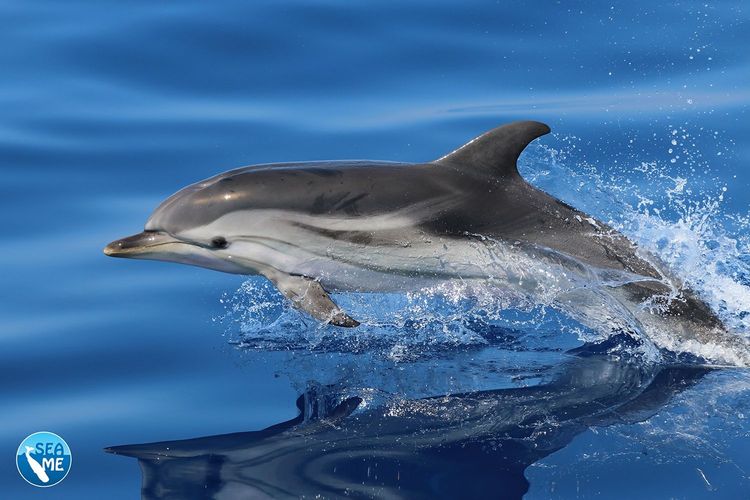
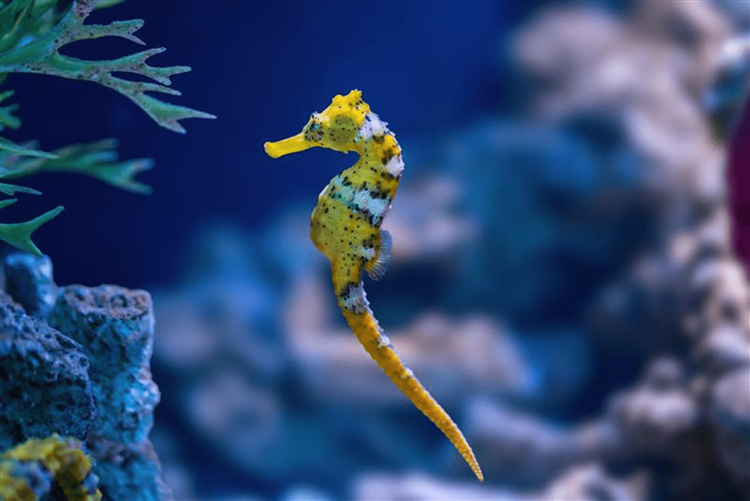
First and foremost, they are biodiversity hotspots. More than 350 species find shelter, food and suitable conditions for reproduction among their leaves and rhizomes.
Posidonia meadows also act as a natural defence for coastlines. Their leaves absorb wave energy, while their rhizomes and roots stabilise the seabed, helping to prevent erosion along sandy beaches.
Finally, Posidonia plays an important role in climate regulation. Posidonia oceanica meadows are major carbon sinks: according to widely cited scientific estimates, one hectare of seagrass meadow can store as much carbon as ten hectares of tropical forest. In the case of Posidonia, the sediments beneath the meadows can hold more than 270 tonnes of carbon per hectare, accumulated over centuries (WWF 2025 report). As long as the meadow remains intact, this carbon stays locked in the seabed. When the meadow is destroyed, it can be released into the atmosphere.
What threatens Posidonia oceanica?
Since the 1950s, Posidonia meadows have undergone significant decline. In some areas, they have lost up to 90% of their original extent, while more than 30% of Posidonia meadows across the Mediterranean are estimated to have disappeared. Human activities along the coast are the main driver.
One of the major threats is bottom trawling. Although trawling over Posidonia meadows is prohibited, illegal fishing still occurs, uprooting entire plants and damaging the matte. This creates a double impact: the plant is lost and carbon stored in the matte can be released.
Pollution is another major pressure. Chemical pollutants and increased water turbidity can affect seagrass meadows by reducing the amount of light reaching the leaves. Coastal development and the impacts of climate change add further pressure.
Today, however, one of the most direct threats to Posidonia oceanica meadows is boat anchoring, particularly during the summer season.
Boat anchoring: how it damages Posidonia meadows
When an anchor is dropped onto a seagrass meadow, the anchor and its chain can tear through leaves, rhizomes and sometimes entire plants, leaving visible scars and craters on the seabed.
The WWF 2025 report, “Safeguarding Mediterranean Seagrass Blue Forests: Anchoring Impacts”, highlights the scale of the problem. A single anchoring event involving a large yacht can destroy 30–100 square metres of seagrass meadow, while more than 5 million square metres are damaged every year, particularly in heavily frequented bays.
Overall, around 50,000 hectares of seagrass meadows are considered at risk, with the potential loss of ecosystem services estimated at around €4 billion per year. Vessels over 24 metres account for approximately 60% of the affected area. The most critical areas are concentrated in Italy, Spain, Türkiye, Greece, Croatia, France, Malta and Cyprus.
One possible solution is the installation of regulated mooring fields, which allow boats to moor without anchoring directly onto the seabed. This protects seagrass meadows while also enabling responsible use of coastal areas.
For this reason, all of One Ocean Foundation’s Posidonia planting activities take place within Marine Protected Areas or regulated mooring fields, such as the mooring field at Cala di Volpe in Sardinia, established more than 20 years ago by Smeralda Holding and now home to One Ocean Foundation’s Blue Forest project. The Cala di Volpe mooring field is a notable example of how coastal management can support marine restoration and has the potential to become the site of the largest marine reforestation initiative in the Mediterranean.
How is Posidonia oceanica protected?
Posidonia is included on the Red List of threatened marine species, while its meadows are recognised as priority habitats under Annex I of the European Habitats Directive 92/43/EEC, which aims to protect natural habitats and wild species. The Directive provides for the designation of Special Areas of Conservation, also known as Sites of Community Importance.
At international level, ecosystem restoration is one of the pillars of the 2030 Agenda. The United Nations has declared the UN Decade on Ecosystem Restoration (2021–2030), with the goal of preventing, halting and reversing ecosystem degradation across every continent and ocean. The UN also supports the 30x30 initiative, which aims to protect at least 30% of the world’s land and marine areas by 2030.
How is Posidonia oceanica restored? Marine reforestation
Protecting the meadows that remain is the first priority. Where Posidonia has already been damaged, however, marine reforestation can help support ecosystem recovery by introducing new plants to degraded areas.
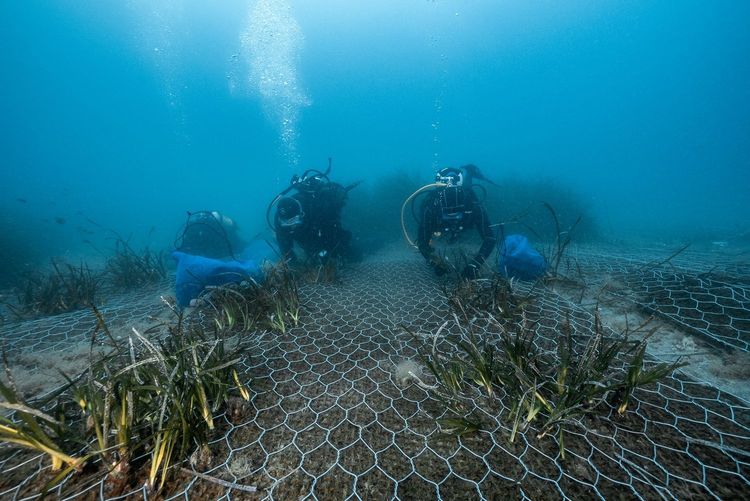
One of the methods most frequently used by One Ocean Foundation involves placing coconut-fibre biomats on the seabed, often combined with a metal mesh, and attaching Posidonia cuttings to them. The cuttings are collected exclusively from plants that have already been naturally uprooted and washed away from the seabed, without damaging healthy meadows.
Another, more recent approach uses metal stakes approximately 30 cm long to anchor individual cuttings directly to the seabed.
A further, still experimental approach involves washed-up Posidonia seeds. Posidonia flowering is a rare event. When fruits are washed ashore, their seeds can be collected, germinated in the laboratory and later transplanted into restoration sites. This is the approach being tested by One Ocean Foundation in the Torre Guaceto Marine Protected Area, in Puglia.
Planting, however, is only the beginning. Following each intervention, universities and research institutions monitor restoration sites for years to assess survival rates and determine which techniques are most effective. Restoration is a long-term process, and scientific research is an essential part of it.
What can you do to protect Posidonia oceanica?
Much of the damage to Posidonia happens because its meadows are invisible from the surface. If you are boating, you can help by avoiding anchoring over seagrass meadows, using designated mooring fields where available and choosing sandy seabeds away from the dark patches that indicate the presence of Posidonia. Learning about Posidonia and helping others understand its importance can also make a difference. And if you would like to support marine research and restoration, you can do so directly through One Ocean Foundation.
Frequently Asked Questions about Posidonia oceanica
Is Posidonia oceanica an algae?
No. It is a marine plant with roots, rhizomes and leaves.
Where does Posidonia oceanica grow?
Only in the Mediterranean Sea. It is an endemic species.
How fast does Posidonia grow?
Very slowly — around 1–2 cm per year. This means that damage to a meadow can take decades or even centuries to recover from.
Why is Posidonia called the “lung of the Mediterranean”?
Because it produces oxygen through photosynthesis, generating up to 20 litres of oxygen per day for every square metre of meadow.
Why is Posidonia oceanica protected?
It is included on the Red List of threatened marine species, while its meadows are classified as priority habitats under the European Habitats Directive 92/43/EEC.
Can Posidonia meadows be restored?
Yes. Marine reforestation can involve transplanting Posidonia cuttings or seeds and monitoring them over time. However, successful restoration requires years of work, monitoring and scientific research.