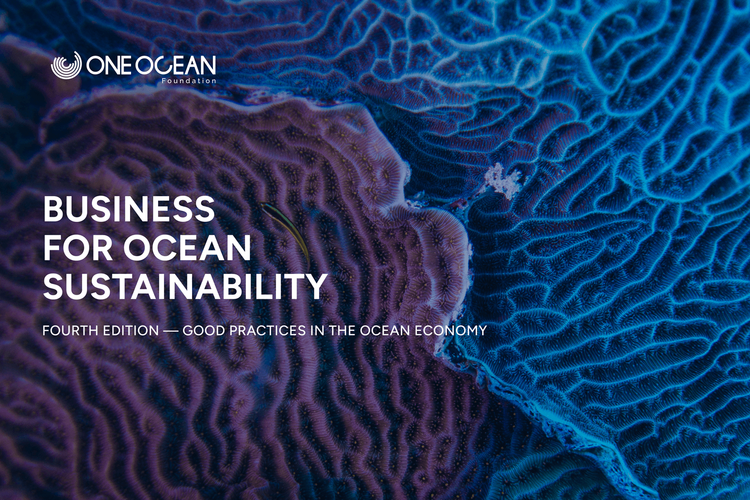
One Ocean Foundation publishes a new edition of its Business for Ocean Sustainability research project, this time focusing on Good Practices in the Ocean Economy. The report examines the good practices documented by 70 of the world's leading companies across four key sectors: maritime transport, shipbuilding and ship repair, ports and warehousing, and fisheries and aquaculture.
These sectors are central to the ocean economy, but they also exert direct pressures on marine and coastal ecosystems. These include greenhouse gas (GHG) emissions, underwater noise pollution, marine litter, contaminants and the introduction of non-indigenous species. Understanding which solutions companies are already implementing is an important step towards identifying what works in practice and encouraging the adoption of good practices across sectors.
The report is the latest development in Business for Ocean Sustainability (B4OS), a multi-year research project launched by One Ocean Foundation in 2019 in collaboration with SDA Bocconi School of Management Sustainability Lab, McKinsey & Company and the Spanish National Research Council (CSIC).
Previous editions assessed companies' awareness of their impacts on the ocean and the extent of their efforts to address them. This latest edition goes one step further: rather than focusing solely on commitments and intentions, it documents solutions that companies are already putting into practice.
DOWNLOAND THE REPORT
How the analysis was conducted
For each sector, we developed a list of good practices, covering concrete technologies and innovative solutions designed to prevent, mitigate or remediate pressures on the ocean. These lists are based on the sector-specific reviews developed within our Ocean Impact Initiative framework.
Building on this work, we analysed the 2024 sustainability and annual reports of 70 companies.
The assessment combined generative artificial intelligence with the expertise of the Foundation's analysts, who verified every finding against the original company reports. A practice was only counted when the report confirmed that it was already being implemented. Commitments, intentions and future plans were not included.
Key findings: how companies are reducing their impact on the ocean
The analysis reveals significant progress, but also highlights an uneven distribution of good practices across the different areas of environmental impact.
- Reducing emissions remains the top priority: 97% of companies report at least one good practice aimed at reducing GHG emissions, including energy efficiency measures, alternative fuels and electrification.
- Other environmental pressures receive less attention: 63% of companies report at least one practice addressing marine litter, 60% biodiversity loss and 57% contaminants.
- Few companies address the full range of pressures on marine ecosystems: only 39% report good practices across all four areas analysed: GHG emissions, marine litter, contaminants and biodiversity loss.
- Ocean conservation is more common than action to reduce companies' direct impacts on marine life: 77% of companies support ocean conservation through NGOs or their own projects. However, only 37% report practices specifically designed to reduce their own impact on marine life and the seabed.
- SDG 14 is frequently mentioned but rarely linked to measurable targets: 60% of companies refer to SDG 14, Life Below Water, in their reports, but only 7% link it to specific targets or measurable corporate objectives.
- Evidence and accountability could be strengthened: only one in four confirmed good practices is supported by third-party verification, with most verified practices relating to GHG emissions.
Good practices already being implemented across ocean economy sectors
The report identifies several solutions that companies are already adopting to prevent and reduce their impact on marine ecosystems.
- Alternative fuels and electrification: companies are using biofuels, LNG, methanol, electric cargo-handling equipment and hybrid vessels. They are also installing renewable energy systems in ports, shipyards and aquaculture facilities.
- Energy efficiency and shore power: ships and port facilities are adopting measures to reduce fuel consumption, while shore power systems allow vessels at berth to connect to the electricity grid instead of keeping their engines running.
- Vessel speed reduction: sailing at lower speeds helps reduce emissions, underwater noise pollution and the risk of collisions with whales and other cetaceans, delivering additional benefits for marine biodiversity.
- Alternative antifouling coatings: low-friction, biocide-free hull coatings help reduce fuel consumption and the release of potentially harmful substances into the marine environment.
- Waste management and recycling: onboard waste treatment systems, recycling initiatives in shipyards and circular approaches to materials in fisheries and aquaculture help prevent and reduce marine litter.
- Recirculating and closed-containment aquaculture systems: these technologies help prevent fish escapes and reduce nutrient discharges into the marine environment.
Most of the practices assessed are already being implemented by at least one company in the sample, suggesting that technology is not the main barrier. The challenge lies instead in scaling up existing solutions and extending their application to all the major pressures that economic activities exert on marine ecosystems.
By documenting what leading companies are already doing, this report provides businesses, investors and policymakers with a practical reference for extending good practices beyond carbon reduction to address the full range of pressures on the ocean. The goal is to support an ocean economy that can continue to grow while safeguarding healthy marine ecosystems for present and future generations.
Through this new edition of Business for Ocean Sustainability, One Ocean Foundation reaffirms its commitment to supporting companies in their transition towards more ocean-positive business practices. The solutions already exist: the next step is to accelerate their adoption at scale and address every major pressure facing the ocean.