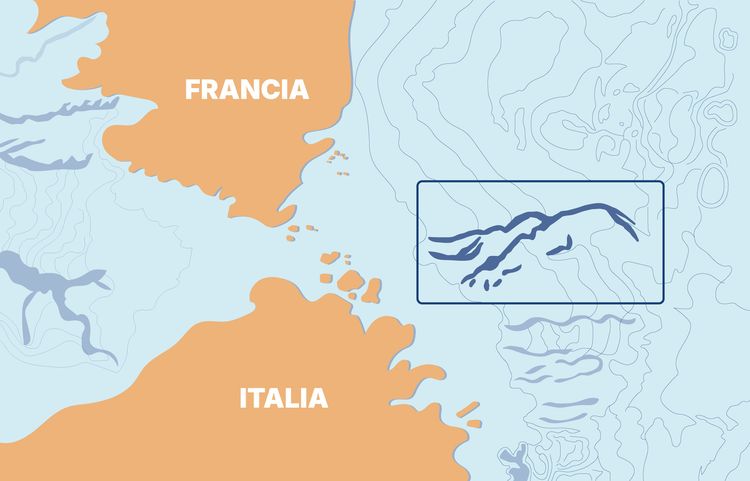
Since 2019, One Ocean Foundation has been studying the Caprera Canyon, one of the most important biodiversity hotspots in the Mediterranean. Recently, the foundation and field researchers completed the final 4 of 11 total missions using the Multipluto submarine, revealing previously unexplored deep-sea habitats. The dives revealed both white coral reefs teeming with marine life and the first signs of human impact on the seafloor.
Thanks to this project, the Canyon has become one of the most extensively studied canyons in the Mediterranean, and one of the very few to be explored across a wide bathymetric range between 130 and 1,050 meters. In particular, this latest round of exploration successfully mapped the deep zone between 300 and 500 meters, which was previously unstudied. In this area, highly developed white coral reefs were sighted, characterized by a high density of Madrepora oculata colonies. The extent of these structures—internationally classified as VMEs (Vulnerable Marine Ecosystems)—is among the largest ever observed in the Mediterranean.
In addition to this VME, another important biocoenosis was identified: muddy bottoms populated by the sea pen Funicolina quadrangularis, known to host commercially valuable species such as Norway lobster (scampo) and deep-water rose shrimp. This latest research further demonstrates that the Caprera Canyon is an extraordinarily rich environment, hosting an exceptional variety of benthic communities.
Despite these extraordinary discoveries, the Multipluto submarine also detected various types of marine litter on the seafloor, such as lost fishing lines, suggesting that recreational fishing represents one of the primary threats to the area. This crucial finding serves as a powerful reminder of the vital role of scientific research and the urgent need to protect these vulnerable ecosystems.